Search

Please enter a keyword or what you are looking for in the field below to search.

alt
Search result
There is no result for your search, please check again.
    alt alt alt alt
    alt alt alt alt
    alt

    Same Machine, Same Parameters — Why Are the Machining Results Still Different?

    Same machine, same parameters, different results? Learn the four hidden variables behind machining inconsistency and how process monitoring enables early warning.

    Scroll

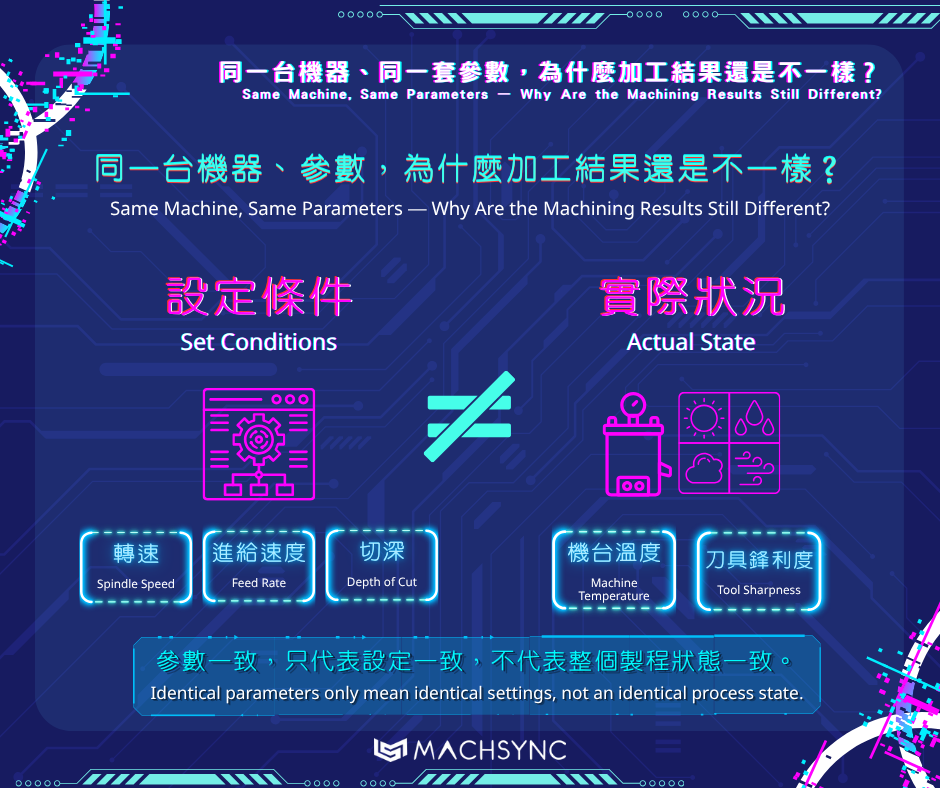
    Identical parameters only mean identical settings, not an identical process state.

    On the shop floor, a seemingly contradictory situation comes up often: the same machine, the same tool, identical machining parameters, and even the same batch of material, yet the results are not the same. Sometimes the dimensions drift; sometimes the surface quality differs; sometimes the first part comes out fine, but parts made later gradually show defects.


    The reason is that parameters such as spindle speed, feed rate, and depth of cut describe the "set conditions," which are not the same as the "actual state" at the moment of cutting. For example, the spindle setting may be identical while the machine temperature is different; the feed rate may be the same while the tool sharpness is not. These changes may not show up on the operator interface, yet they can gradually show up in the machining results.

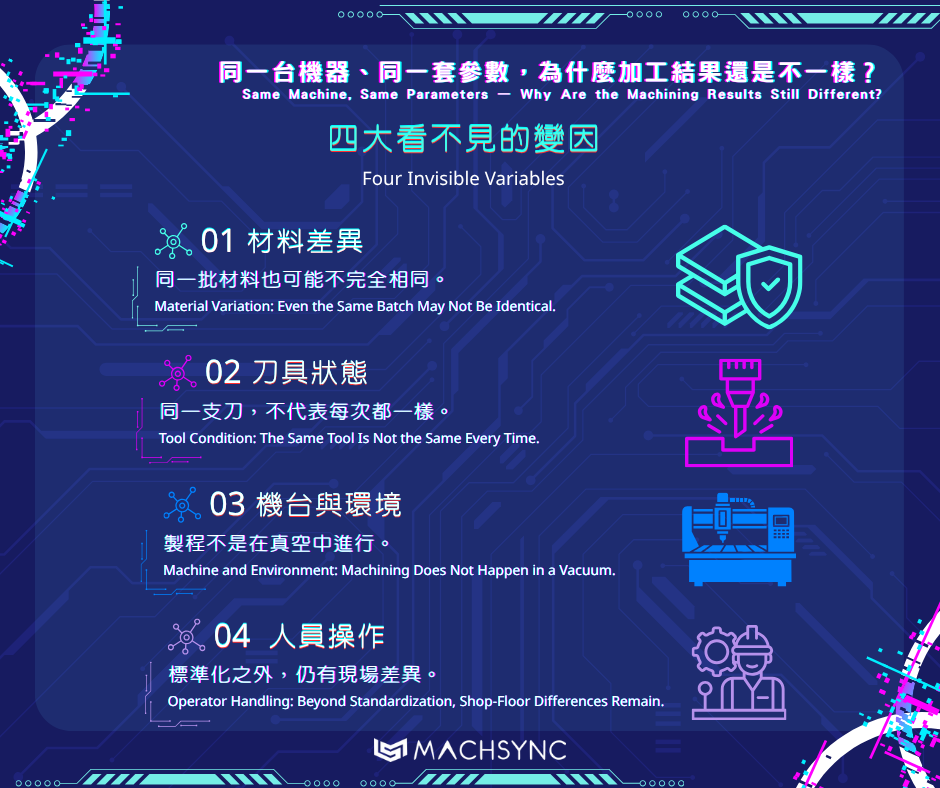
    Four Invisible Variables

    ① Material Variation: Even the Same Batch May Not Be Identical

    Even with the same specification and the same supplier, differences in hardness, microstructure, or internal stress may exist between batches. These are hard to notice under normal conditions, but when accuracy requirements rise and the process is already near the limit of its capability, such differences can be amplified into changes in cutting load, vibration, or part dimensions. So when batch-to-batch variation appears, it is not enough to check the machine parameters; the material batch and its condition should also be included in the analysis.


    ② Tool Condition: The Same Tool Is Not the Same Every Time

    A new tool and one that has already machined dozens or hundreds of parts will behave differently in actual cutting, even with identical parameters. Tool wear is usually gradual:

    Slight wear → change in cutting behavior → higher machining load → gradual dimensional drift → out of tolerance

    Although many processes set a tool life or a part-count limit, the actual wear rate is not consistent under different machining conditions. Rather than only recording "how many times it has been used," observing the actual state during machining provides a more reliable basis for tool life management.


    ③ Machine and Environment: Machining Does Not Happen in a Vacuum

    Temperature rise after long operation, environmental vibration, coolant condition, and the operation of nearby equipment can all change the machining conditions. In high-precision machining, thermal deformation in particular cannot be ignored. The first part machined in the morning and a part machined after several hours of continuous operation may be made with equipment in different states. If only the program and parameters are recorded, there is no way to know about these changes as they happen.


    ④ Operator Handling: Beyond Standardization, Shop-Floor Differences Remain

    Even when the program is standardized, differences in workpiece fixturing position, clamping force, tool installation, tool-change timing, and cleanliness can still show up in the results as accuracy requirements increase. The purpose of standardization is not merely to create an SOP, but to make sure key conditions can be verified and recorded, so that the cause can be found when an abnormality occurs.


    What Really Matters Is What Happened Before the Results Changed

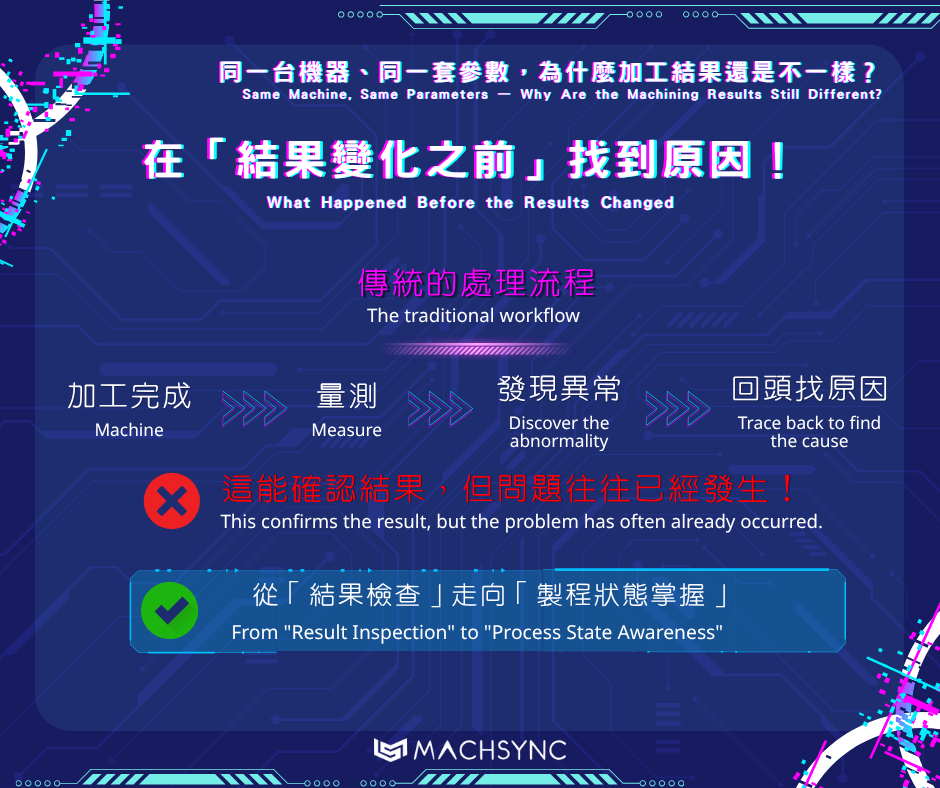
    The traditional workflow is: machine → measure → discover the abnormality → trace back to find the cause. This confirms the result, but the problem has often already occurred.

    If signals during machining, such as cutting force and vibration, can be observed, it becomes possible to see abnormal trends before the results change:

     • Parts 1–20: machining signals stable

     • Parts 21–40: cutting load gradually increases

     • After part 41: vibration begins to change

     • Part 50: part dimensions exceed the acceptance limit


    What we see then is not just "part 50 is defective," and we can go further and trace back: when exactly did the abnormality begin? This is the value of process monitoring.

    From "Result Inspection" to "Process State Awareness"

    The core of quality management is not eliminating every variable, because in a real manufacturing environment, materials, tools, equipment, and the environment are always changing. What truly matters is whether we can know what is changing in the process.

    When signals from the machining process can be continuously collected and analyzed, the question shifts from "Is this part defective?" to "Is the process changing right now?" and further to "Could this change be a precursor to a later abnormality?"


    When a manufacturing site moves from "parameter management" to "state management," the value of monitoring goes beyond recording data. It helps us understand: What state is the process in now? When did the abnormality begin? Before the results got worse, were there already observable signals?

    This is an important step in smart machining's progression from "monitoring" to "early warning."

    Sources: Public domain references

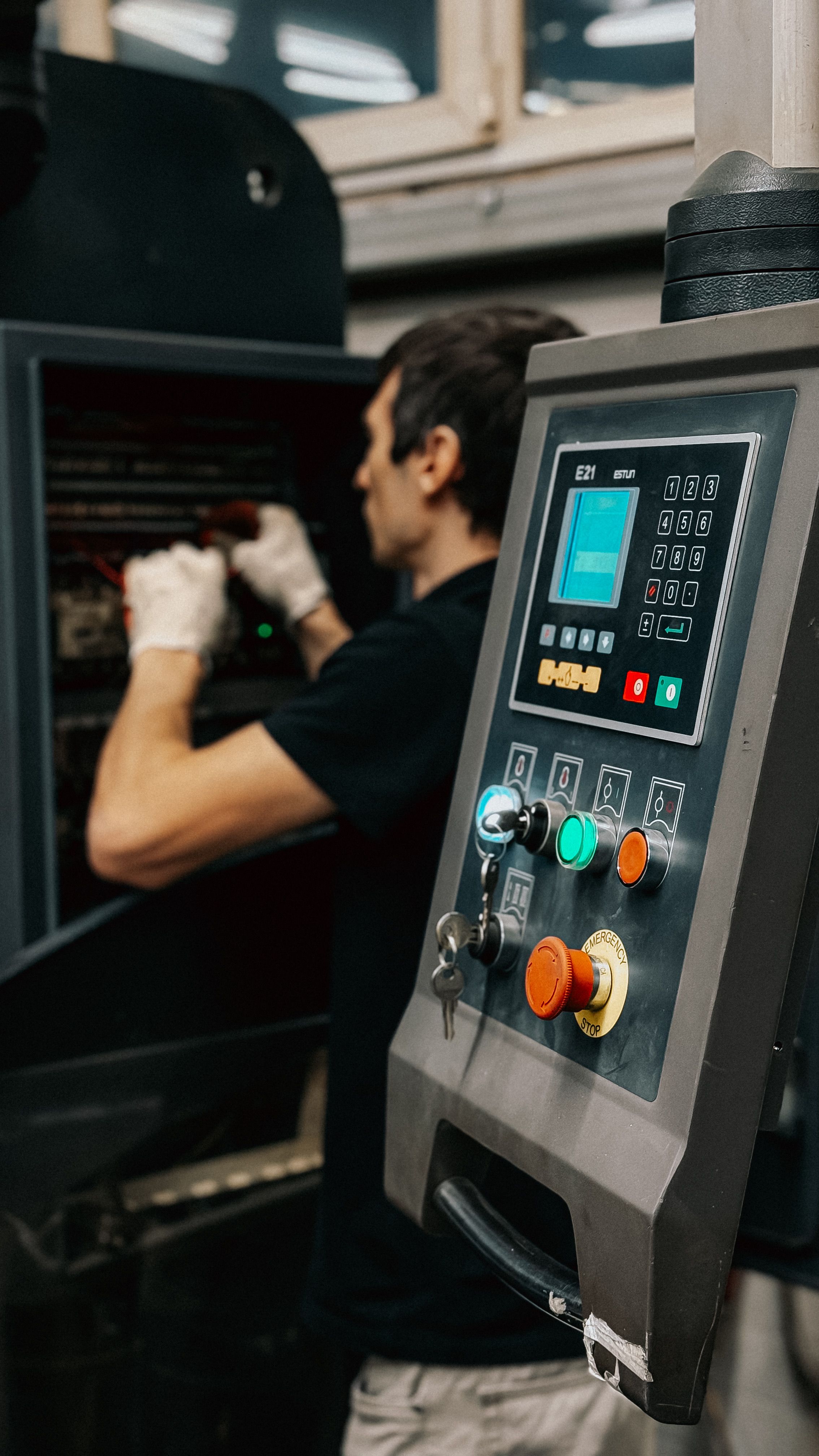
    Photo by Bulat843

    Some visual content on this page was created or edited with the assistance of generative AI.

    This article is original content created by Machsync. It may not be used for commercial purposes or distributed, shared, or sold in any form. Unauthorized reproduction, excerpting, copying, or use in any visual format is strictly prohibited. 

    For reprint or licensing inquiries, please contact Machsync.

    ﹌﹌﹌﹌﹌﹌﹌﹌﹌﹌﹌﹌﹌﹌﹌

    📬 Get in Touch with Machsync

    📍 2F., No. 38, Keya Rd., Daya Dist. Taichung City, Taiwan

    📞 +886-4-2473-6883

    ✉️ admin@machsync.ai